Mitigating the Urban Heat Island Effect as an example of regulating ecosystem services
This topic presents a proposed method for assessing and mapping the cooling effect of urban heat islands in the Lubuskie Voivodeship. The analysis focuses on Zielona Góra and Gorzów Wielkopolski, their Functional Urban Areas (FUAs) and landscape units used as the basic aggregation layer for assessing ecosystem services.
1. Urban heat island
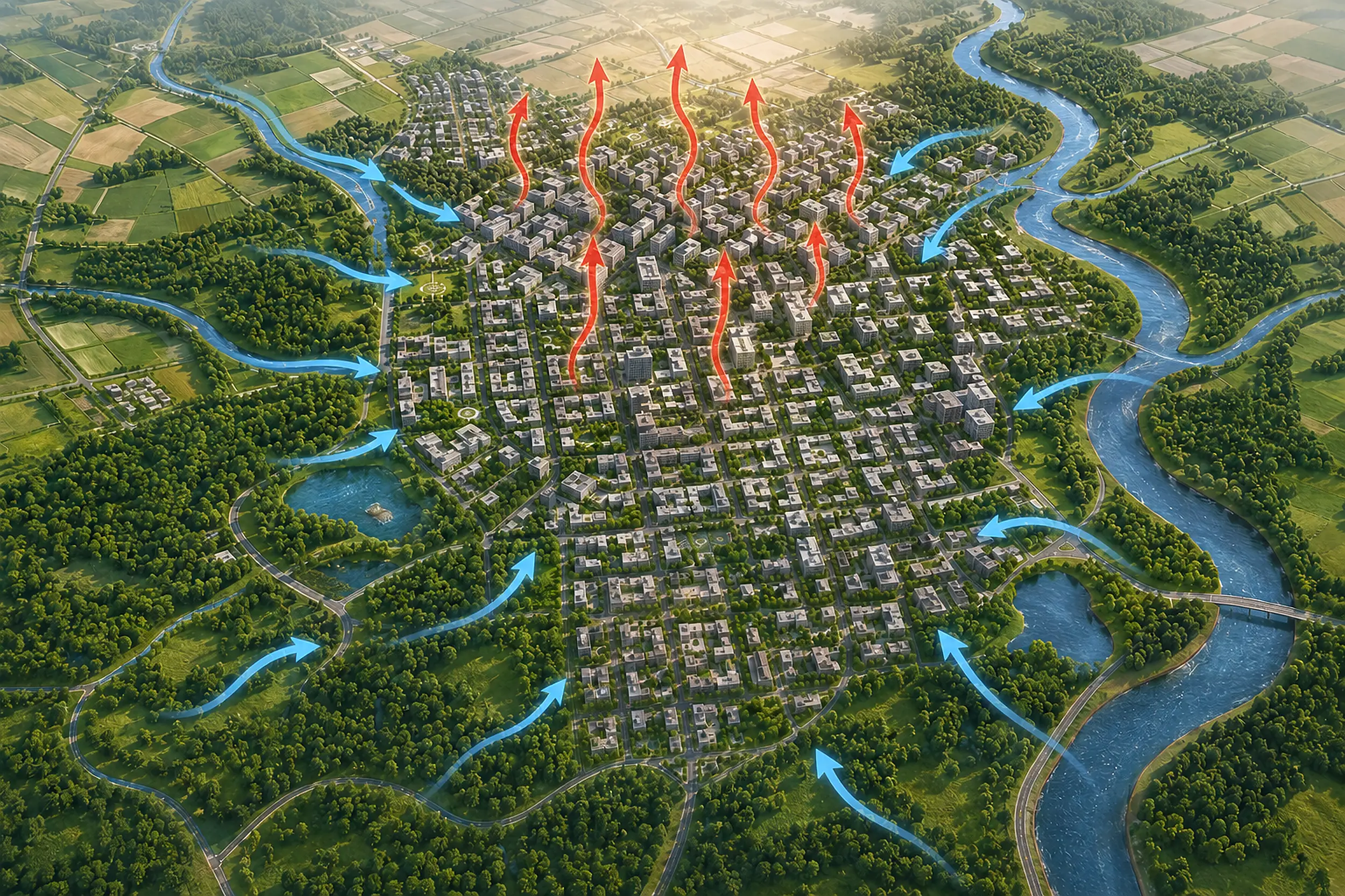
Urban heat islands are among the clearest climatic effects of urbanisation. They arise where natural or semi-natural surfaces are replaced by dense development and impervious materials, which store heat, limit evapotranspiration and modify the local surface energy balance (Oke, 1982; Voogt & Oke, 2003). The urban heat island effect occurs when cities, characterized by heat-absorbing concrete and asphalt, become significantly warmer than the surrounding rural areas. To counteract this, urban planners use “air corridors” or “ventilation paths” — such as green belts, parks, or specially designed street layouts — to allow cooler air from suburban areas to penetrate densely built-up districts. Structural planning is also essential: using varied building heights and orienting streets according to prevailing wind directions (in line with the principles of urban roughness) helps dissipate heat. The use of cooling, light-reflective materials on roofs and roads is equally important, as it reduces the overall amount of retained heat and enhances the effectiveness of ventilation.
Studies carried out in Polish cities, including Łódź, Warsaw, Kraków and Poznań, show that the intensity and spatial pattern of urban thermal anomalies depend on land use, building density, atmospheric circulation, relief, vegetation structure and the wider landscape setting (Kłysik & Fortuniak, 1999; Bokwa et al., 2015; Kuchcik et al., 2014; Półrolniczak et al., 2017). Satellite-derived Land Surface Temperature, especially from Landsat thermal imagery, makes it possible to assess the Surface Urban Heat Island in relation to vegetation cover, sealed surfaces and functional land-cover types (Weng et al., 2004; Majkowska et al., 2017; Renc et al., 2022). Green areas, open soils and blue-green infrastructure reduce overheating mainly through shading, evapotranspiration and the cooling properties of water and vegetation (Bowler et al., 2010; Kumar et al., 2024). In this context, the analysis for the Lubuskie Voivodeship, covering Zielona Góra, Gorzów Wielkopolski and their Functional Urban Areas, provides a spatial basis for identifying where natural cooling potential is strongest and where adaptation measures should be prioritised.
2. Urban heat island cooling as an ecosystem service
Urban heat island cooling describes the ability of natural and semi-natural components of the urban and peri-urban landscape to reduce excessive surface and air temperatures. The effect is generated mainly by vegetation, shaded surfaces, evapotranspiration, soil moisture, blue infrastructure and the continuity of ventilation corridors. It is therefore a regulating ecosystem service with direct relevance for climate adaptation, public health and the quality of life in cities exposed to heat waves.
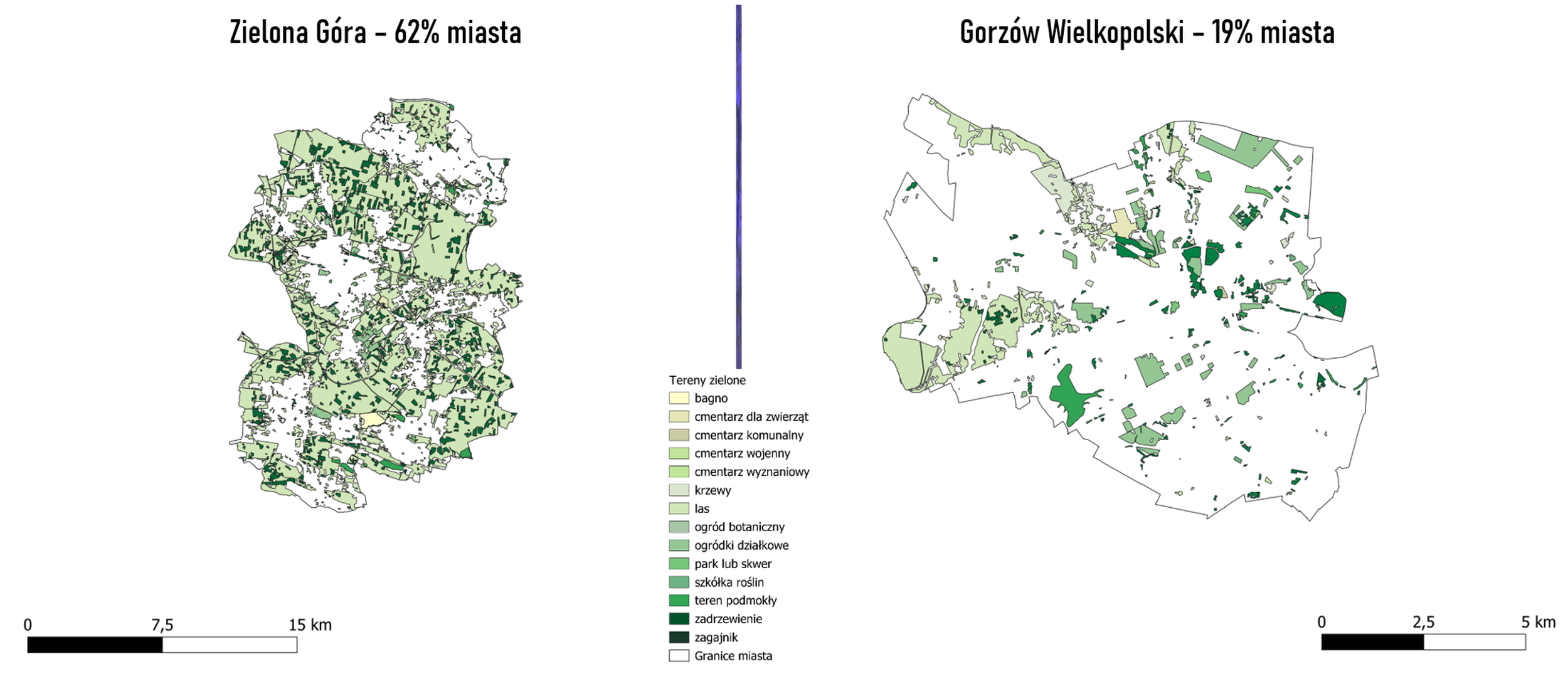
In Lubuskie Voivodeship, the cooling service is particularly relevant for two regional urban systems: Zielona Góra and Gorzów Wielkopolski. The two cities have different landscape structures. Zielona Góra is characterised by a high percentage of green areas, while Gorzów Wielkopolski has a higher proportion of impervious surfaces. This contrast makes the two FUAs useful examples for interpreting how landscape structure controls the intensity and spatial persistence of surface urban heat islands.
3. Spatial reference framework: Landscape Units and FUAs
The assessment uses two complementary spatial reference levels. The first level consists of landscape units specified in the regional landscape audit. These units provide a consistent framework for interpreting how land cover, land use and landscape composition influence the cooling effect. This is important because cooling is generated by the physical structure of the landscape rather than by administrative boundaries alone.
The second level is the Functional Urban Area. In the SUHI workflow, the FUA represents the wider urban-rural system surrounding each core city and provides the reference background for calculating temperature differences. Results at FUA level show how the cooling service is distributed across the broader functional region and how peri-urban forests, agricultural landscapes, waters and open areas mitigate overheating in the city core.
4. Methodological basis, satellite data and spatial data
The methodology integrates satellite-derived land surface temperature with vector spatial data and landscape-unit statistics. Land Surface Temperature (LST) was derived primarily from Landsat 8 imagery because its spatial resolution is suitable for detecting intra-urban thermal contrasts. MODIS data were used as a complementary source to fill gaps in Landsat scenes where cloud cover produced NoData values. Google Earth Engine supported automated acquisition and pre-processing, while QGIS was used for spatial modelling, raster-vector integration and final SUHI calculations.
| Data group | Source or layer | Role in the analysis |
| LST data | Landsat 8; MODIS | Determining the LST, filling in data gaps and establishing the thermal conditions for calculating the SUHI index. |
| Administrative masks and FUA | BDOT10k / boundaries from the Geoportal | The designation of urban areas and larger urban functional reference areas. |
| Water bodies and wetlands | PTWP, OIMK, SWRS, SWKN from BDOT10k | Elimination of the cooling effect of water in the SUHI 2 quality control variant. |
| Landscape units | Regional landscape audit | Aggregation of the SUHI index and explanatory variables into units relevant to planning. |
| Land cover structure | Green spaces and impervious surfaces | An analysis of cooling and overheating mechanisms at city and FUA level |
Table 1. Input data used in the workflow
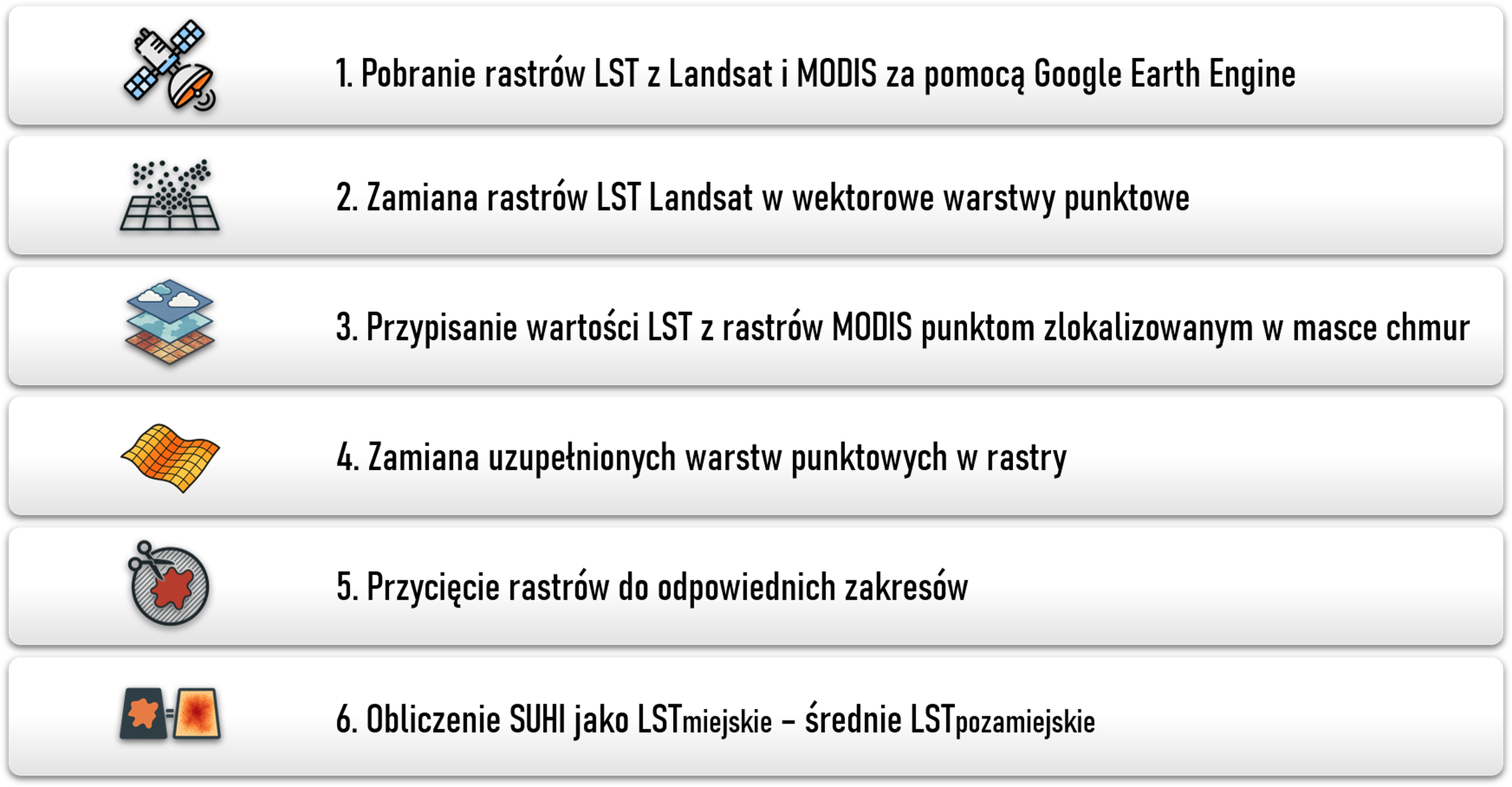
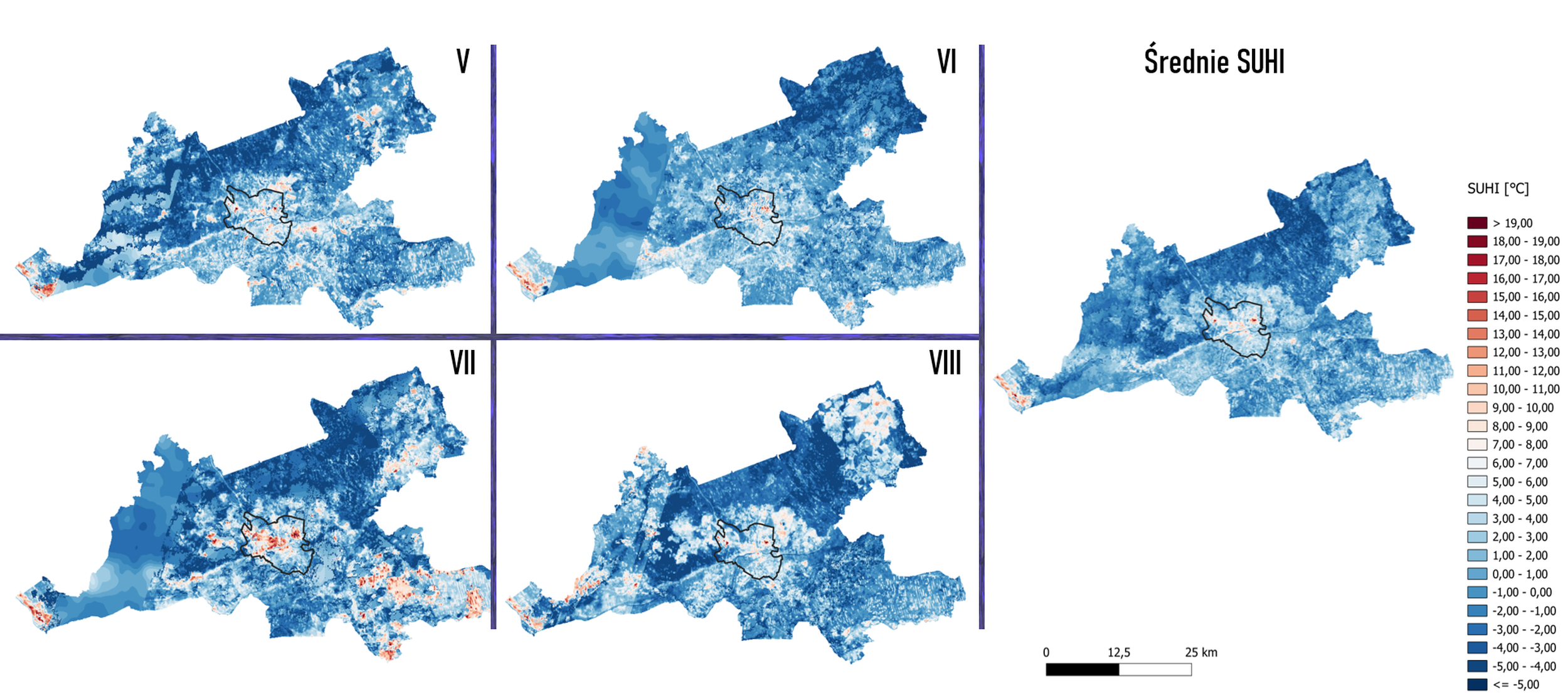
Two SUHI variants were considered. SUHI 1 is the main indicator and expresses the difference between the surface temperature in the city and the mean surface temperature of the surrounding FUA/rural reference area. SUHI 2 repeats the calculation after removing surface waters, wetlands and buffered rivers from the analysis. The purpose of SUHI 2 is to test whether natural blue-infrastructure cooling distorts the assessment of the built environment. The comparison showed only minor differences, so SUHI 1 can be treated as the main representative benchmark.
5. Results for Zielona Góra and its FUA
Zielona Góra shows a strong natural cooling potential. Green areas account for more than 60 percent of the city, while impervious surfaces represent about 7 percent. This composition strongly reduces average SUHI intensity and explains why the cooling effect is more visible here than in Gorzów Wielkopolski. However, the city still contains clear hotspots associated with dense residential estates, industrial and warehouse areas, compact urban layouts and other highly sealed surfaces.
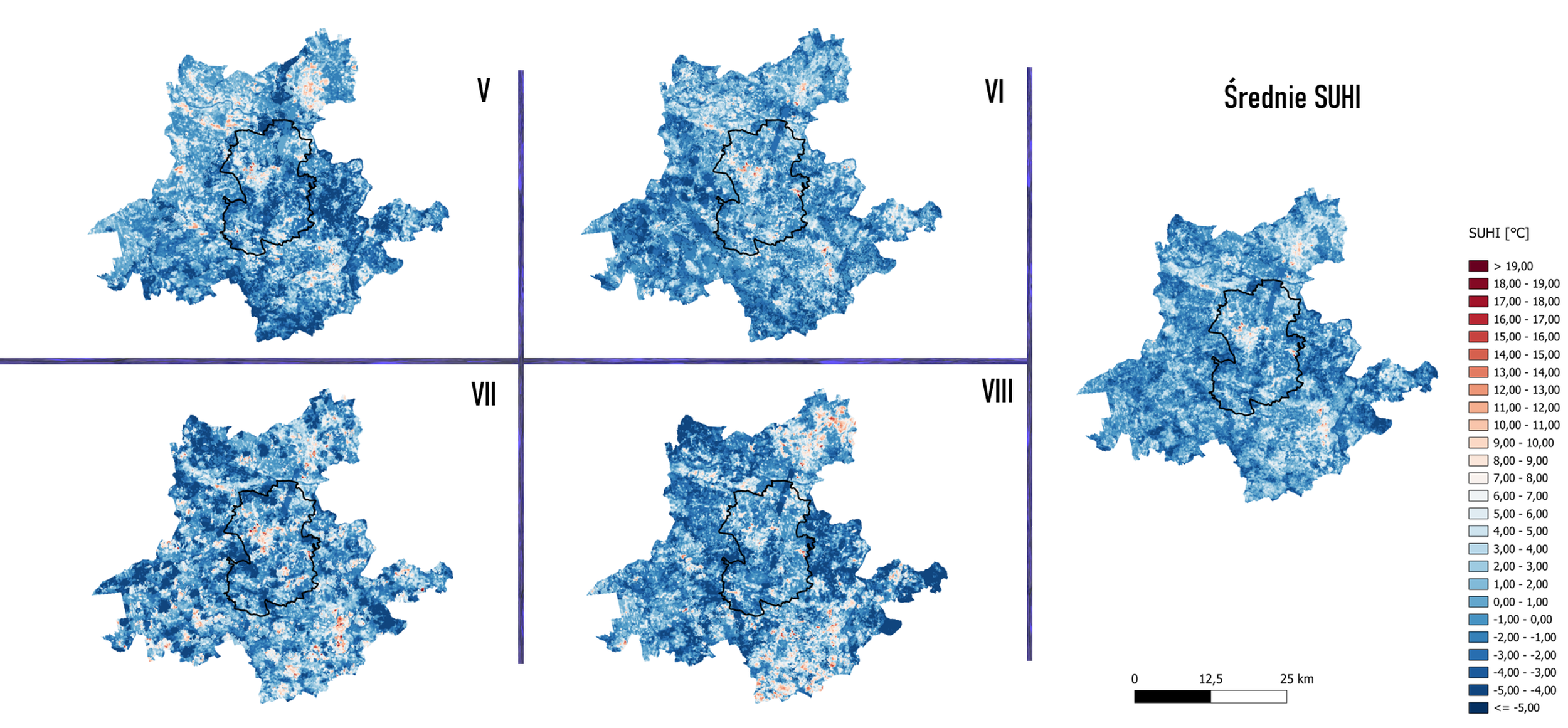
At FUA scale, the wider urban-rural system around Zielona Góra acts as a cooling background. Forested areas, agricultural landscapes and lakes form a regional thermal buffer, while selected urbanised or industrial landscape units remain warmer. The FUA result is important because it demonstrates that the cooling effect is not confined to the administrative city. It depends on the continuity of green and blue infrastructure across the functional region.
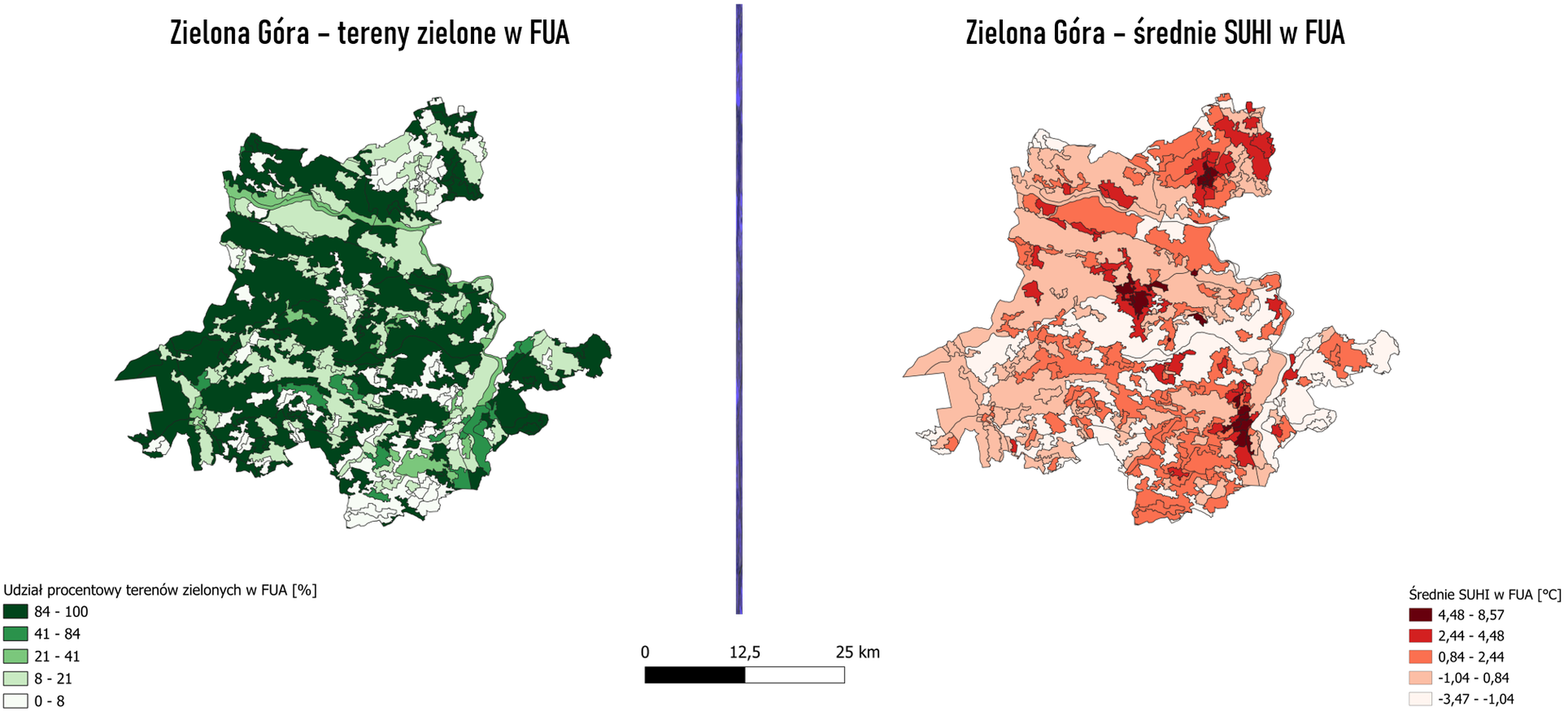
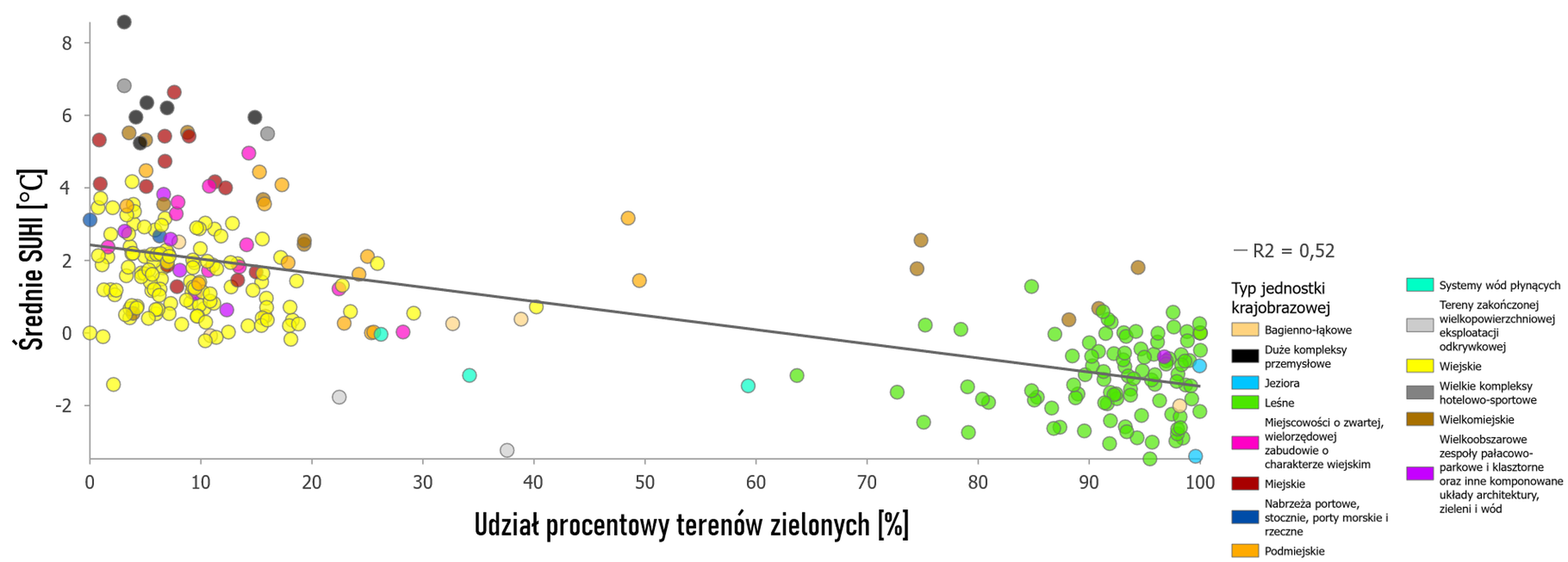
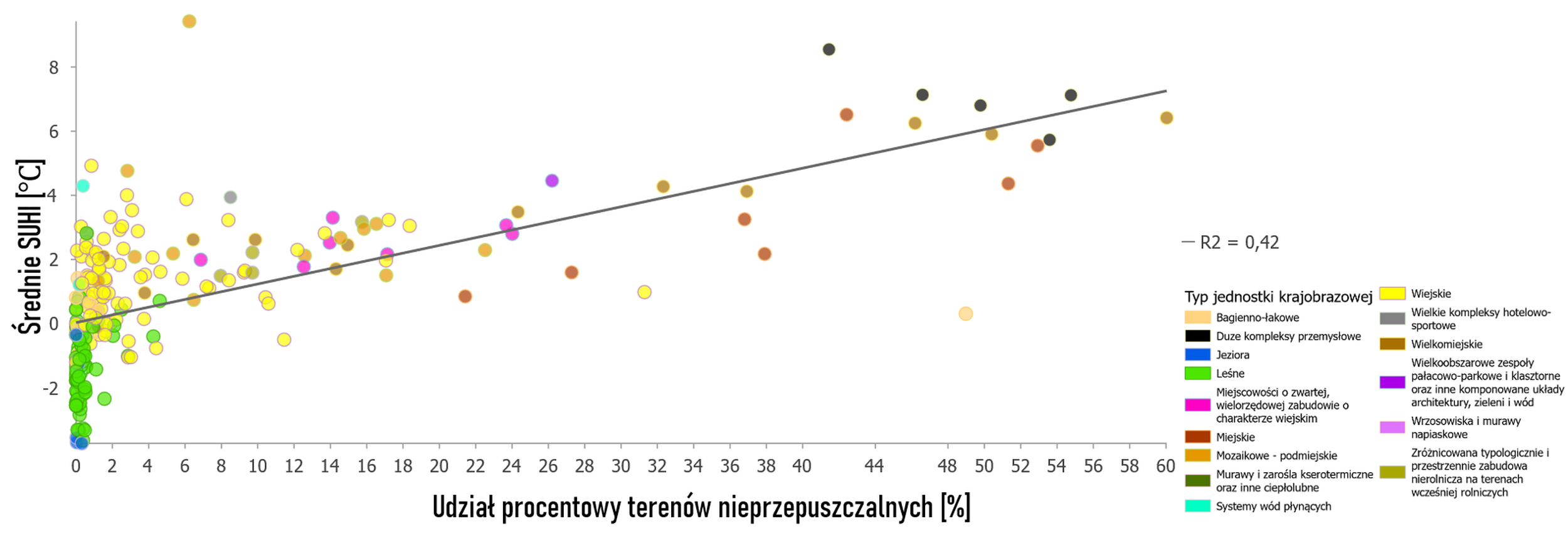
The relationship between average SUHI and green areas is clearly negative in both the city and the FUA. Landscape units with high proportions of forests, agricultural land and other green surfaces generally show lower SUHI values. The highest average SUHI values occur in large industrial complexes, hotel and sport complexes, and urban settlements with preserved historical layouts. This confirms that the proportion and continuity of vegetation are central to heat mitigation.
Impervious surfaces show the opposite pattern. In the Zielona Góra FUA, landscape units with a higher share of sealed surfaces usually record higher average SUHI values. This relationship identifies places where adaptation should focus on reducing land sealing, introducing tree cover, improving soil permeability and protecting existing cooling corridors.
6. Results for Gorzów Wielkopolski and its FUA
Gorzów Wielkopolski presents a different thermal and landscape pattern. Green areas represent just under 20 percent of the city, while impervious surfaces account for approximately 18 percent. Consequently, the city is more vulnerable to the intensification of SUHI, especially in industrial areas, large production and storage zones, metropolitan residential areas and compact historical urban layouts.
At FUA level, the surrounding landscape partly mitigates overheating, but the cooling signal is less consistent than in Zielona Góra. The negative correlation between green areas and SUHI is weaker. This may be caused by the scattered distribution of green spaces, their lower continuity, and the stronger influence of sealed urban and industrial surfaces.
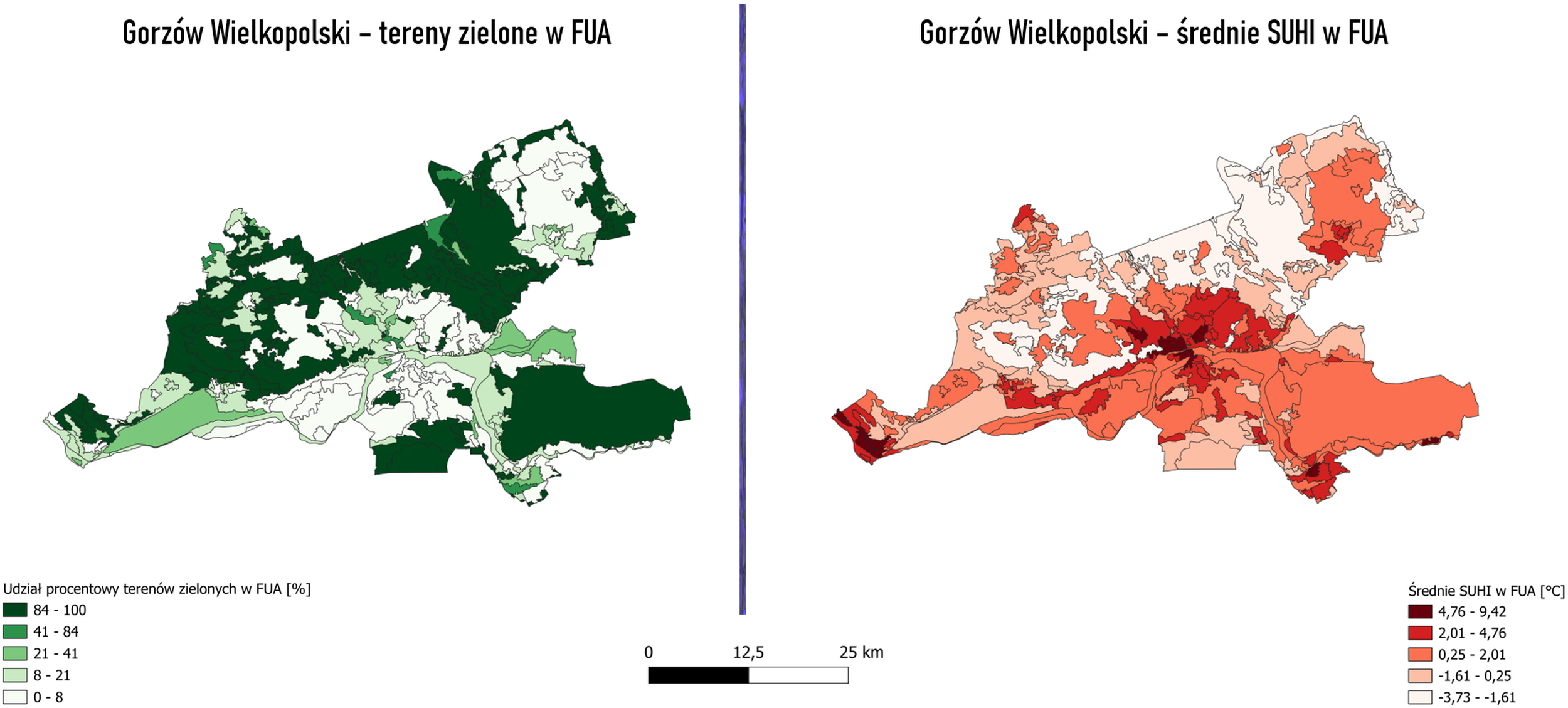
Forest areas, large necropolises and lakes are among the landscape units with the highest proportion of green or cooling components, whereas suburban mosaic landscapes and industrial units show higher average SUHI values. The role of impervious surfaces is especially clear: in both the city and the FUA, an increase in sealed surfaces translates into higher average SUHI.
7. Comparative interpretation and planning use
The comparison of both FUAs shows that the cooling effect of the urban heat island can be operationalised as a landscape-level ecosystem service. Zielona Góra benefits from a stronger and more continuous green structure, which reduces SUHI and creates a wider cooling background in the FUA. Gorzów Wielkopolski has a more fragmented green structure and a higher share of impervious surfaces, which makes the urban heat signal more pronounced and spatially persistent.
| Area | Dominant cooling factor | Dominant heating factor | Planning implication |
| Zielona Góra (town) | High proportion of green spaces (>60%) | Local industrial clusters and densely built-up residential areas | To safeguard the continuity of forests, parks, allotments and urban green corridors. |
| Zielona Góra (FUA) | Regional forest, agricultural and lake areas | Selected industrial areas and densely populated urban areas | Use suburban areas as a cooling buffer and limit the expansion of impervious surfaces. |
| Gorzów Wielkopolski (town) | Local green spaces, cemeteries and forests | A high proportion of impervious surfaces (~18%) and industrial areas | In areas particularly vulnerable to heatwaves, priority should be given to removing hard surfaces, providing shade and implementing measures under the green-blue strategy. |
| Gorzów Wielkopolski (FUA) | Wooded areas, lakes and regional open spaces | A patchwork of suburban areas, industrial zones and densely populated urban areas | Strengthen the connections between green spaces and maintain ventilation corridors. |
Table 2. Results
For Zielona Góra, the main planning objective should be to maintain the continuity and quality of existing green infrastructure. Priority should be given to preventing fragmentation of forests, allotments, parks and peri-urban green corridors, especially in landscape units located close to SUHI hotspots. For Gorzów Wielkopolski, the priority should be to reduce the impact of sealed areas and to introduce cooling interventions in industrial, storage and compact residential zones.
The FUA perspective is essential for climate adaptation because it shows that the cooling service is generated not only within the city, but also by the surrounding functional landscape. Forests, lakes, agricultural land, open areas and ventilation corridors located outside the administrative city boundary can reduce the thermal contrast observed in the urban core. At the same time, suburban sealing and industrial expansion can weaken this regional cooling function.
The proposed approach is suitable for monitoring. Repeated observations from Landsat, supported by MODIS gap filling and vector spatial data from BDOT10k and the landscape audit, can be used to track changes in the cooling service over time. Because the results are aggregated to landscape units and FUAs, they can support regional spatial planning, climate adaptation programmes, ecosystem-service valuation and the prioritisation of local adaptation measures.
In practical terms, the results should be used to identify landscape units where the cooling service should be protected, restored or strengthened. Units with low green-area shares and high impervious-surface shares should be treated as priority areas for adaptation. Units with high cooling potential should be protected as part of the regional green-blue infrastructure system, especially where they contribute to thermal comfort in neighbouring urban areas.
8. HeatCool Index
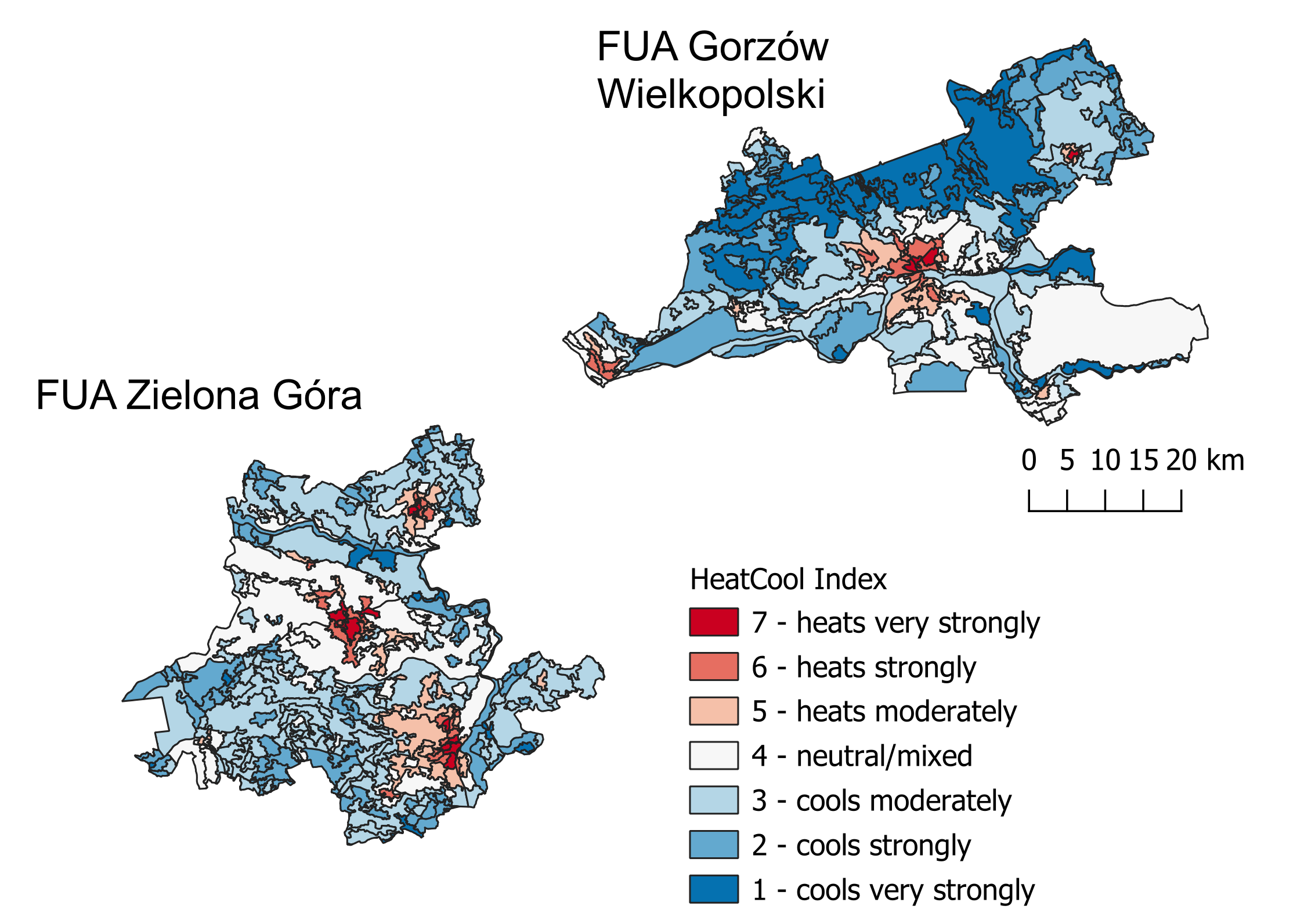
The HeatCool Index has been developed to assess the cooling (or warming) effect of adjacent landscape units. The HeatCool Index should be interpreted as a synthetic measure of the direction and strength of a landscape unit’s influence on thermal conditions. The lower the index value, the greater the unit’s cooling potential; the higher the value, the greater the potential for enhancing the SUHI.
The index was constructed from standardised variables, which allows for the comparison of measures expressed in different units, such as:
- percentage of green space,
- median NDVI,
- proportion of water bodies,
- degree of imperviousness,
- neighbourhood measures.
The results of the work are maps for the Zielona Góra FUA and the Gorzów Wielkopolski FUA, which colour-code information on the cooling effects of landscape units. The redder the landscape unit, the greater the warming effect on neighbouring units. Dark blue units are the most significant in terms of mitigating the urban heat island effect.
Bibliography
Bokwa, A., Hajto, M. J., Walawender, J. P., & Szymanowski, M. (2015). Influence of diversified relief on the urban heat island in the city of Kraków, Poland. Theoretical and Applied Climatology, 122, 365–382. https://doi.org/10.1007/s00704-015-1577-9
Bowler, D. E., Buyung-Ali, L., Knight, T. M., & Pullin, A. S. (2010). Urban greening to cool towns and cities: A systematic review of the empirical evidence. Landscape and Urban Planning, 97(3), 147–155. https://doi.org/10.1016/j.landurbplan.2010.05.006
Kłysik, K., & Fortuniak, K. (1999). Temporal and spatial characteristics of the urban heat island of Łódź, Poland. Atmospheric Environment, 33(24–25), 3885–3895. https://doi.org/10.1016/S1352-2310(99)00131-4
Kuchcik, M., Błażejczyk, K., Milewski, P., & Szmyd, J. (2014). Urban climate research in Warsaw: The results of microclimatic network measurements. Geographia Polonica, 87(4), 491–504. https://doi.org/10.7163/GPol.2014.33
Kumar, P., Debele, S. E., Sahani, J., Aragão, L., Barisani, F., Basu, B., Bucchignani, E., Charizopoulos, N., Di Sabatino, S., Domeneghetti, A., Edo, A. S., Finér, L., Gallotti, G., Juch, S., Leo, L. S., Loupis, M., Mickovski, S. B., Panga, D., Pilla, F., … Zieher, T. (2024). Urban heat mitigation by green and blue infrastructure: Drivers, effectiveness, and future needs. The Innovation Geoscience, 2(2), 100071. https://doi.org/10.59717/j.xinn-geo.2024.100071
Majkowska, A., Kolendowicz, L., Półrolniczak, M., Hauke, J., & Czernecki, B. (2017). The urban heat island in the city of Poznań as derived from Landsat 5 TM. Theoretical and Applied Climatology, 128, 769–783. https://doi.org/10.1007/s00704-016-1737-6
Oke, T. R. (1982). The energetic basis of the urban heat island. Quarterly Journal of the Royal Meteorological Society, 108(455), 1–24. https://doi.org/10.1002/qj.49710845502
Półrolniczak, M., Kolendowicz, L., Majkowska, A., & Czernecki, B. (2017). The influence of atmospheric circulation on the intensity of urban heat islands and urban cold islands in Poznań, Poland. Theoretical and Applied Climatology, 127, 611–625. https://doi.org/10.1007/s00704-015-1654-0
Renc, A., Drobniak, A., & Ogrodnik, K. (2022). Spatial structure of surface heat and cold islands in summer based on Landsat 8 imagery in southern Poland. Ecological Indicators, 145, 109645. https://doi.org/10.1016/j.ecolind.2022.109645
Voogt, J. A., & Oke, T. R. (2003). Thermal remote sensing of urban climates. Remote Sensing of Environment, 86(3), 370–384. https://doi.org/10.1016/S0034-4257(03)00079-8
Weng, Q., Lu, D., & Schubring, J. (2004). Estimation of the relationship between land surface temperature and vegetation abundance for urban heat island studies. Remote Sensing of Environment, 89(4), 467–483. https://doi.org/10.1016/j.rse.2003.11.005