
Reducing air pollution as an example of regulating ecosystem services
This topic presents a proposed method for identifying areas characterised by elevated concentrations of air pollutants, using nitrogen dioxide (NO₂) in the Lubuskie Voivodeship as an example. The identification of zones with the highest concentration levels is of significant importance from the perspective of environmental management and spatial planning. It enables local authorities to take measures aimed at reducing pollutant emissions and minimising their negative impact on residents’ health and the functioning of the natural environment.
The analyses focus on the areas of Zielona Góra and Gorzów Wielkopolski, their functional urban areas (FUAs) and landscape units used as the basic aggregation layer in the assessment of ecosystem services. The study covers data for the year 2024, and maps of the spatial distribution of NO₂ concentrations were generated using a hexagonal grid. A grid with a resolution of 7 was used for the functional urban areas, whilst a more detailed grid with a resolution of 9 was used for the urban areas of Zielona Góra and Gorzów Wielkopolski. This approach made it possible to capture the spatial variation in pollutant concentrations at both regional and local scales.
The chosen level of aggregation allows for the analysis of relationships between the degree of urbanisation, land use, and the environment’s potential to provide ecosystem services. The method used aims not only to identify areas particularly vulnerable to high NO₂ concentrations, but also to lay the foundations for further analyses related to air quality assessment and the support of environmental and transport policies at local and regional levels.
1. Air pollution
Air pollution is one of the most serious environmental problems facing the modern world. Increasing urbanisation, industrialisation and the rapid growth of road transport have contributed to a rise in emissions of harmful substances into the atmosphere (Swain, 2024). These pollutants can be either gaseous or particulate in nature, and their source is mainly human activity: the burning of fossil fuels, industrial production, agriculture and the heating of buildings. Depending on atmospheric conditions and terrain, the concentration of these substances can vary significantly over time and space.
Pollution is particularly problematic in large cities and industrial areas, where emission levels far exceed the environment’s capacity to neutralise them (Ballschmiter, 1992). The most common air pollutants include sulphur oxides (SO₂), nitrogen oxides (NOₓ), carbon monoxide (CO), tropospheric ozone (O₃) and particulate matter (PM10 and PM2.5). Depending on atmospheric conditions, these compounds may undergo chemical reactions, horizontal and vertical transport, as well as accumulation in poorly ventilated areas, which makes their dispersion processes extremely complex. Among these, nitrogen dioxide (NO₂) is a particularly significant compound, being one of the main components of nitrogen oxides (NOₓ). Although present in the atmosphere in relatively small quantities, this compound has a significant impact on human health (Dobrzyńska, 2016) and the state of the natural environment (Seangkiatiyuth et al., 2011).
2. Research objectives and methodology
A fundamental prerequisite for implementing effective air quality improvement strategies is a precise understanding of the spatial distribution of pollutants and the identification of the factors responsible for their accumulation. Traditional monitoring stations, whilst providing accurate measurements, have a limited range.
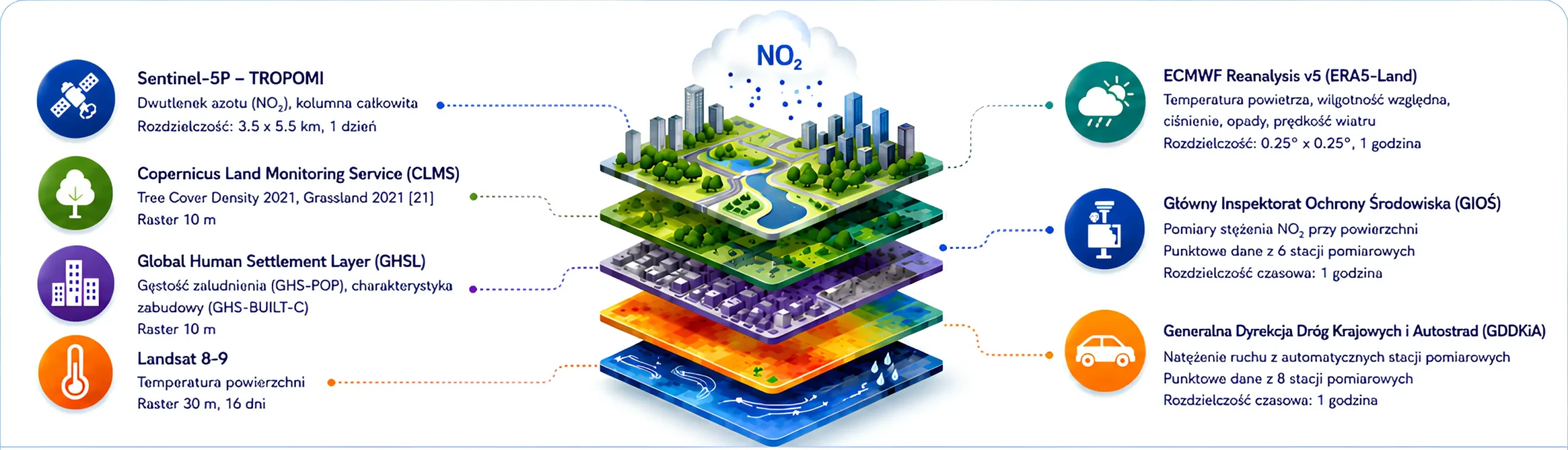
For this reason, an advanced machine learning model was developed as part of the project, enabling the estimation and monitoring of nitrogen dioxide (NO₂) levels in areas lacking physical monitoring infrastructure. The modelling results for the studied Functional Urban Areas allow spatial planners to move from general concepts to precisely targeted mitigation measures, such as the designation of clean transport zones or the design of buffer green spaces.
2.1. Multidimensional integration of environmental data
The modelling process required the incorporation of highly heterogeneous datasets reflecting the various factors affecting air quality.
2.2. Use of a hierarchical hexagonal lattice
In order to spatially standardise the collected data, the traditional rectangular grid was replaced with a hierarchical H3 hexagonal grid. This decision was driven by significant analytical benefits. Hexagons are characterised by an equal distance from the centre to all neighbouring cells, which significantly reduces spatial distortions and sampling errors. Furthermore, the hierarchical nature of the H3 index enabled smooth and lossless data scaling – from cells with an area of approx. 5.16 km² used in the model training phase, to the target high-resolution grid (approx. 0.11 km²) used to produce subsequent maps.
2.3. Spatial aggregation accounting for wind dynamics
Air pollutants are constantly transported through the atmosphere. To ensure the model realistically captures these dynamics, explanatory variables (e.g. land cover, road infrastructure) were not assigned to the grid in a static manner. Instead, feature values were calculated as a weighted average from hexagons located within the so-called upwind area. The extent of the analysed area and the weights assigned to it were dynamically determined by the wind direction and speed at a given measurement hour.
2.4. Model architecture and bias correction
The basis for estimating NO₂ concentrations was the Random Forest Regression algorithm, which analysed 33 input parameters. This tool was selected due to its high resistance to overfitting and its effectiveness in modelling non-linear environmental relationships.
However, models based on decision trees have an inherent mathematical limitation, leading to the phenomenon of ‘regression to the mean’. In practice, this means the algorithm tends to smooth out results and underestimate extreme values (local pollution peaks). As the identification of critical hotspots was the main objective of the project, the Empirical Distribution Matching (EDM) technique was implemented in the final stage of the work.
3. Results
By applying a trained artificial intelligence model, verified with high accuracy using validation data, it was possible not only to generate precise pollution maps but also to gain a deep understanding of the mechanisms that shape them. The key findings from the analysis conducted for the study areas are presented below.
3.1. Main factors influencing NO₂ concentration levels
Feature importance analysis in the machine learning algorithm and linear correlation analysis clearly demonstrated that air quality is determined by the synergy of environmental and anthropogenic factors. The most important factors include:
- meteorological conditions and seasonal cycles: Air temperature and wind speed have by far the greatest influence on pollutant dispersion. Falls in temperature during the colder months drastically worsen air quality.
- traffic and urban development pressure: The most significant local, man-made source of NO₂ is road traffic volume. The accumulation of pollutants also shows a strong, direct correlation with the density of residential and commercial development.
- high vegetation as a buffer: Importantly, the presence of high vegetation (wooded areas, parks) shows a strong negative correlation with NO₂ concentrations. This confirms the role of established vegetation as a natural filter and an indicator of areas with low emission pressure.
3.2. Seasonality of the phenomenon: Summer-Winter contrast
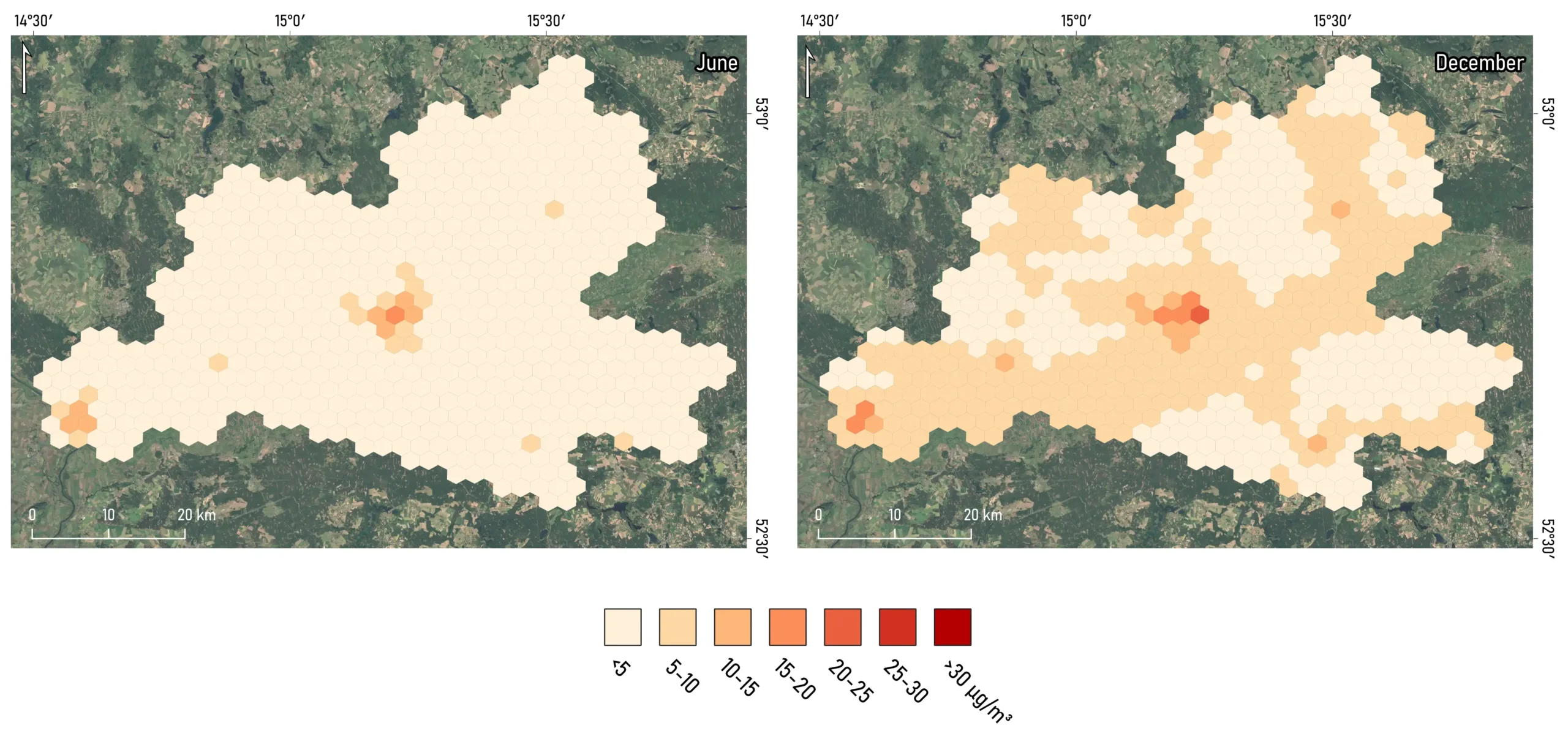
Spatial modelling broken down by month highlighted the dramatic impact of seasonality on the urban microclimate. A comparison of maps from the summer and winter periods reveals two distinct pollution profiles:
- Summer period (June): Characterised by very good overall air quality. Elevated NO₂ concentrations are confined almost exclusively to city centres and are linked to baseline, continuous traffic.
- Winter period (December/January): Reveals a significant deterioration in air quality across extensive areas. This phenomenon results from the overlap of transport emissions with intense activity in the municipal and domestic heating sectors, which is further exacerbated by temperature inversions and light winds.
3.3. Identification of critical areas (hotspots)
The generation of high-resolution maps has enabled the precise identification of areas posing the highest environmental risk. Spatial analysis reveals the presence of pollution on two scales:
Macro level:
Within the studied FUA areas, pollution is not distributed evenly. Distinct, regional ‘islands’ of pollution are clearly visible, corresponding to major urban centres such as Zielona Góra, Nowa Sól and Sulechów. As one moves away from these centres towards agricultural and forested areas, air quality improves dramatically.
Micro-scale (typology of local hotspots):
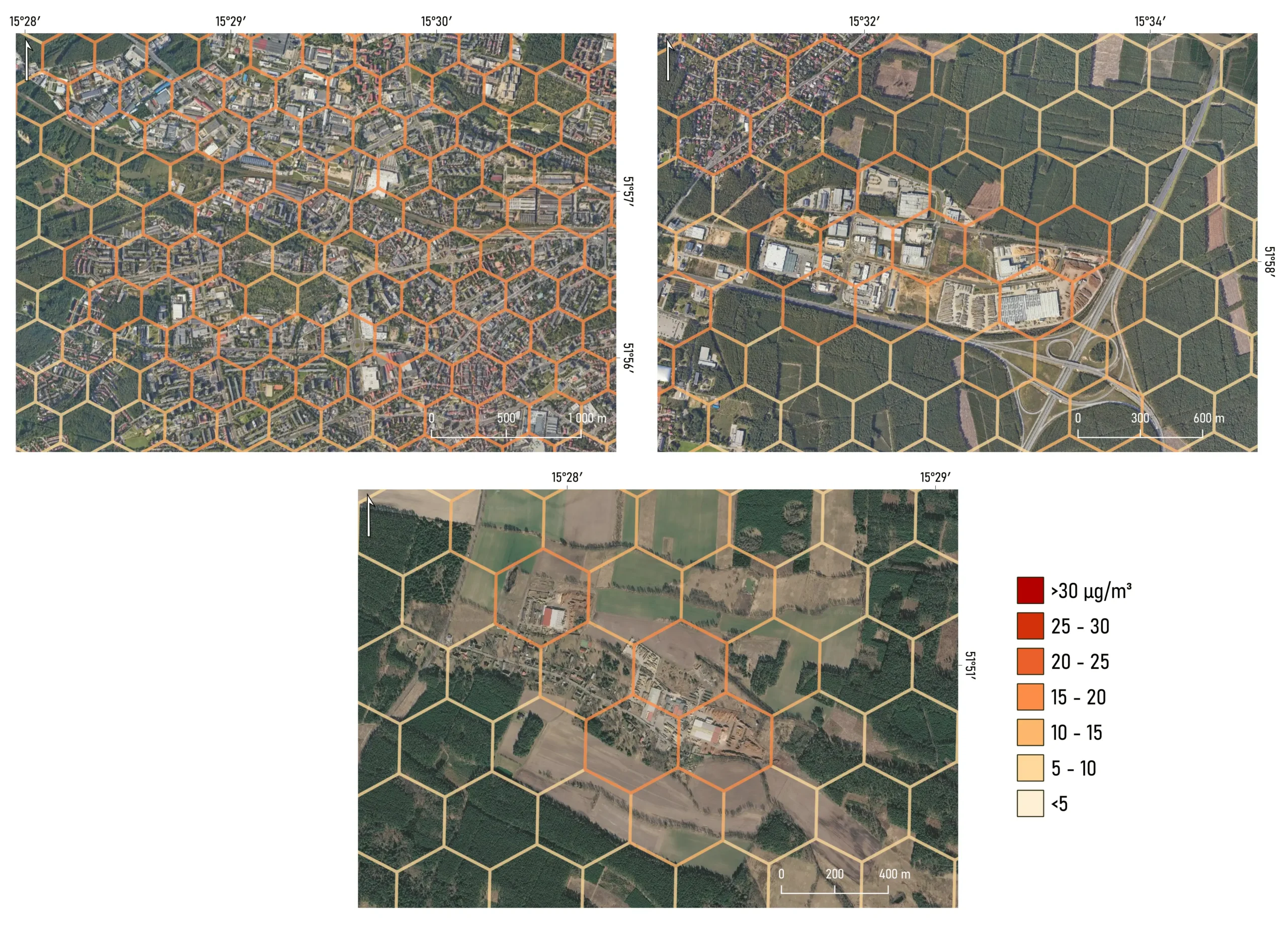
Thanks to the detail of the hexagonal grid, three main types of critical areas requiring tailored interventions have been identified within the cities themselves:
- Dense urban cores: Where traffic in built-up canyons overlaps with local heating systems.
- Industrial and logistics zones and motorway junctions: Where the main culprit is concentrated heavy goods traffic.
- Isolated point sources: Small, peripheral suburban estates where individual heating systems (so-called ‘low emissions’) create strong, localised pollution peaks during the winter season.
4. Comparative analysis: what drives pollution in Gorzów, and what drives it in Zielona Góra?
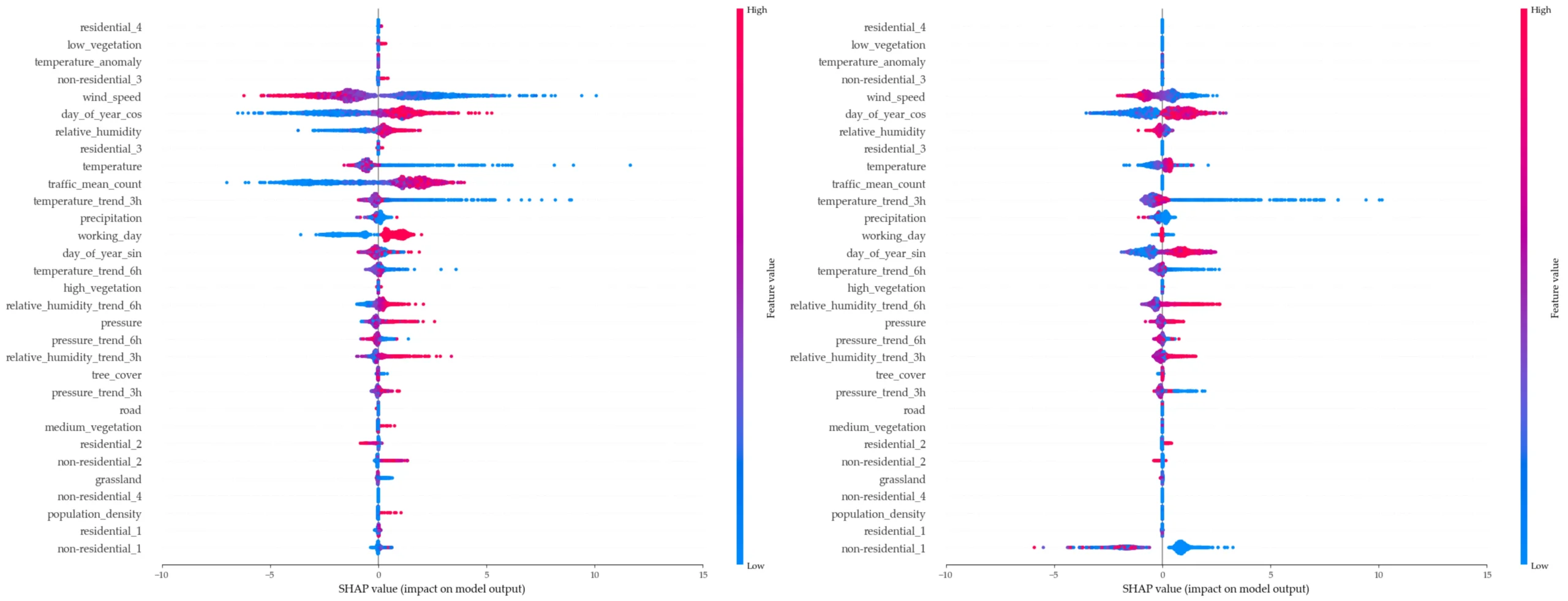
The use of advanced machine learning model interpretation methods (SHAP analysis) allowed us to look ‘inside’ the algorithm and determine which factors have the greatest influence on NO₂ concentrations in individual cities. The results revealed two distinct emission profiles for the cities studied, which stems not only from their urban differences but also from the specific nature of the available input data.
In Zielona Góra, the pollution profile is typical of cities with heavy traffic, which the model was able to capture precisely thanks to access to data from automatic traffic counters.
- Road traffic is the main factor: The variable describing traffic intensity (traffic_mean_count) is one of the most significant factors driving up NO₂ levels.
- The effect of working days: The model identified a very strong influence of the working_day variable, confirming that pollution peaks are closely correlated with residents’ daily commutes to work and school.
- Wind as a natural filter: In Zielona Góra, wind speed (wind_speed) proved to be the most important factor in reducing pollution. A lack of wind immediately results in localised accumulations of exhaust fumes in built-up areas.
The situation is quite different in the graphs for Gorzów Wielkopolski, where the direct impact of traffic volume proved to be significantly less significant. This phenomenon stems directly from the lack of GDDKiA monitoring stations in this area, which created a gap in hard data on traffic flows. In this situation, the artificial intelligence algorithm demonstrated its ability to adapt, basing its predictions on other available variables.
- The variable describing non-residential and commercial areas (non-residential_1) has the strongest influence on the model’s predictions in Gorzów. In the absence of direct traffic counters, it is the spatial distribution of commercial and industrial zones and logistics hubs that has become the algorithm’s indicator of areas with the highest emissions.
- Strong dependence on seasonal background: Seasonal indicators and short-term temperature trends (temperature_trend_3h) topped the list of the most important variables in Gorzów. This indicates that, with limited knowledge of vehicle traffic, the model linked NO₂ fluctuations more strongly to seasonal background (the heating season) and meteorological conditions.
5. How can this data be used? (Practical applications)
- Low Emission Zone (LEZ): The maps provide hard, factual evidence in public debates. They show where restricting combustion engine vehicle traffic will bring the greatest health benefits to residents.
- Development of monitoring networks: The case of Gorzów Wielkopolski clearly demonstrates to decision-makers the need to invest in urban vehicle counting systems, which will make analytical models even more detailed in the future.
- Location of sensitive facilities: The model helps avoid planning errors, such as the construction of new schools, nurseries, hospitals or care homes in areas of chronic accumulation of transport and heating pollution.
- Protection of ventilation corridors: The data demonstrates which undeveloped corridors protect cities from pollution, providing grounds for their legal protection.
The results of the analysis clearly indicate that there is no single universal solution. Strategies must be precisely tailored to the local situation:
- Traffic and transport management: Where pollution is directly driven by the rhythm of commutes, the priority should be to calm traffic in city centres, prioritise public transport, and gradually replace the public transport fleet.
- Spatial planning and buffer green spaces: As the case of Gorzów has shown, pollution is strongly influenced by the development of non-residential areas. Cities should focus on creating dense, green buffer zones around service and industrial areas and must ensure that heavy goods vehicle transit is routed outside the compact urban fabric.
- Development of blue-green infrastructure: The model clearly demonstrated that wind speed is the most effective ‘air purifier’. The absolute investment priority must be the maintenance of natural ventilation channels and the planting of tall vegetation, which acts as a physical and biological filter for exhaust fumes.
Bibliography
Ballschmiter, K. (1992). Transport and Fate of Organic Compounds in the Global Environment. Angewandte Chemie International Edition in English, 31(5), 487–515. https://doi.org/10.1002/anie.199204873
Seangkiatiyuth, K., Surapipith, V., Tantrakarnapa, K., and Lothongkum, A. W. (2011). Application of the AERMOD modelling system for environmental impact assessment of NO₂ emissions from a cement complex. Journal of Environmental Sciences, 23(6), 931–940. https://doi.org/10.1016/S1001-0742(10)60499-8
Swain, C. K. (2024). Environmental pollution indices: A review of heavy metal concentrations in air, water and soil near industrial and urban areas. Discover Environment, 2(1), 5. https://doi.org/10.1007/s44274-024-00030-8